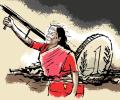
Industry body CII has pitched for a reduction in personal income tax rates, decriminalisation of the goods and services tax and a relook at the capital gains tax rates as part of its agenda presented to the government for the forthcoming Budget. Arguing that the GST law already contains adequate penal provisions for deterrence against evasion of taxes, CII has suggested decriminalisation of GST law. Also, the applicability of prosecution provisions should not be based on the absolute amount of tax evasion but should be based on real intent to evade the taxes and a certain percentage of the tax payable, it stated.

Why did the political system in the country react to these two decisions of the Modi government in a diametrically opposite manner? asks A K Bhattacharya.
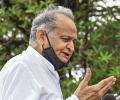
Rajasthan Chief Minister Ashok Gehlot-led Congress government on Wednesday presented the Budget for 2021-22 and said it will bring a Universal Healthcare scheme worth Rs 3,500 crore.

The government will come out with a White Paper on the mismanagement of economy prior to 2014 with an aim to draw lessons.

The new TDP government will have to mop up over Rs 10,000 crore to fulfill the financial requirements for July, a retired senior bureaucrat said.

Karnataka minister Satish Jarkiholi on Wednesday said the guarantee schemes need to be reviewed so that only the economically weaker sections, and not the rich, benefit from them, sparking a debate on the ambitious programmes launched by the Congress government.

Even as Chinese troops continue squatting on territory that we claim as our own -- this was the lowest allocation for defence in percentage terms since the 1950s, reveals Ajai Shukla.

Moody's Analytics said that the reduced political stability and the need for consensus building that is inherent with a coalition government, might erode investor confidence in the near term.

Finance Minister Nirmala Sitharaman on Monday presented the Budget for 2021-22 in the Lok Sabha that is expected to provide relief to the pandemic-hit common man as well as focus more on driving economic recovery through higher spending on healthcare, infrastructure and defence amid rising tensions with neighbours, As India emerges from the COVID-19 crisis, the ninth Budget under the Modi government, including an interim one, is widely expected to focus on boosting spending on job creation and rural development, generous allocations for development schemes, putting more money in the hands of the average taxpayer and easing rules to attract foreign investments.
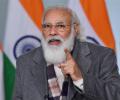
He is not good at thinking through laws and policies. His lockdown produced chaos and misery and didn't stop Covid. His GST finished off thousands of companies and reduced the amount of tax government collects to such an extent that he cannot pay state governments any more, observes Aakar Patel.
The number of centrally sponsored schemes have increased to 35 in FY22 from 30 in FY21 and central sector schemes have increased to 704 from 685 in the previous year, reports Dilasha Seth.

Delhi Finance Minister Atishi on Monday announced the 'Mukhyamantri Mahila Samman Yojana' for the 2024-25 fiscal, under which Rs 1,000 will be given monthly to women aged above 18 from the fiscal year 2024-25.
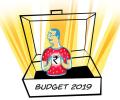
The finance minister is likely to announce the government's vision for a tax-friendly regime by raising the I-T exemption limit from the current Rs 250,000 per annum.
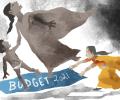
Women and children have been given short shrift with these crucial sectors facing substantive budgetary cuts, discovers Rashme Sehgal.

The finance ministry will kick-start the exercise to prepare the Union Budget for financial year 2022-23 (FY23) from October 12, according to an official notification released on Monday. "The pre-Budget meetings as well as the meetings to discuss the revised estimates will start from October 12 and will continue till the second week of November," according to the Budget circular of the Department of Economic Affairs' Budget Division. The Union Budget is expected to be announced on February 1, as has been the practice of the past few years.

Jarange had also claimed that a poisoning attempt was made against him through saline, though he did not elaborate on it.

"Of the structural reforms, the GST has been the most historic in our country. Its chief architect is not with us today. I pay homage to the visionary leader late Arun Jaitely. GST has been gradually maturing into a tax that has integrated the country economically," she said during her budget speech.
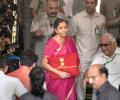
As India emerges from the COVID-19 crisis, the ninth budget under the Modi government, including an interim one, is widely expected to focus on boosting spending on job creation and rural development, generous allocations for development schemes, putting more money in the hands of the average taxpayer and easing rules to attract foreign investments.

He says a Budget is supposed to be about tax and expenditure. "I think he (Finance Minister Pranab Mukherjee) has outlined significant tax reforms, which will be implemented over the next three to six months."

The National Pension System (NPS) added 21.5 per cent fewer fresh subscribers under the corporate segment in 2023 compared to the preceding year. Government officials and experts attribute it to the higher exemption limit of income tax of Rs 7 lakh announced in the FY24 Budget that no more requires employees under this income bracket to opt for NPS for tax-saving purposes. Data collated from the Ministry of Statistics and Programme Implementation (MoSPI) reveals that the corporate component is voluntary in nature and saw 158,212 new subscribers in 2023 compared to 201,517 during 2022.

The fitment committee under the Goods and Services Tax (GST) Council, comprising central and state officials, has begun a rate rationalisation exercise afresh, checking the possibility of dropping some of the rates, particularly the 12 per cent slab, to achieve a revenue-neutral structure, a senior official with direct knowledge of the matter
The winter session of Parliament usually starts from the last week of November or the first week of December, while the budget session starts from the last week of January and the Union Budget is tabled on February 1.
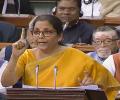
'The economy needed 3 or 4 major fixes. The major one was, of course, the direct tax structure, but we ended up complicating the existing convoluted tax structure,' says M R Venkatesh, chartered accountant and lawyer.

But it is disappointing to note that Sitharaman's third Union Budget continues to promote a few problematic ideas, observes A K Bhattacharya.

Do the actual numbers bear out the claims made by the government or do they suggest something else? asks A K Bhattacharya.

'The vision now is not just to look at national highways as a number of kilometres, but quality as well.'

In fact, no other recent Union Budget has held so much significance for the Indian economy as the one to be presented in about six weeks from now, notes A K Bhattacharya.
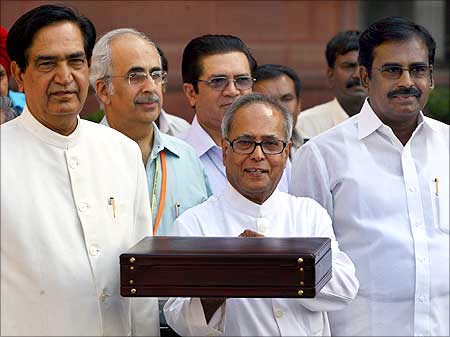
The sad truth is that the debt-to-GDP ratio will shoot up close to 90 per cent in the coming year, and the fiscal deficit glide path does not promise to reduce it substantially any time soon, predicts Mihir S Sharma.
Prime Minister Narendra Modi on Thursday asked his Council of Ministers to make extra efforts for effective implementation of public welfare schemes at the ground level and work on new ideas in their ministries ahead of the budget.

The central government's Great Nicobar development project, proposed around an unprecedented transhipment port, will be executed to keep environmental impact minimal, and is essential as it is of national importance, the government has said amid calls to abort the controversial project due to ecological concerns, the Centre said in an official statement.
There are several welcome standalone reforms, but these do not add up to a coherent strategy to achieve a $5 trillion economy or secure Aatmanirbharta, observes Rathin Roy.

'Investors should not go for lump-sum investments in infrastructure funds at this point.' 'The SIP route is the best to avoid any major disappointment.'
"The Railway Minister has presented a very responsible, practical and implementable budget," Chidambram told reporters outside Parliament.
Concerned over poor budget allocation for the farm sector, Agriculture Minister Sharad Pawar on Sunday said it may be difficult to implement the proposed Food Security Bill without adequate funds to boost agri-output, a must for increased foodgrain requirement.
China on Friday hiked its defence budget to $209 billion, maintaining a single-digit growth for the sixth consecutive year with a 6.8 per cent increase in 2021.
The Union government is projected to share about 32 per cent of central taxes with states during the financial year 2024-25 against the 15th Finance Commission's recommendation of 41 per cent. The Revised Estimates (RE) for FY24, too, show a similar share of states in the central taxes at 32 per cent. In absolute terms, however, there has been an increase in the amount devolved to states compared to the Budget Estimates (BE) for FY24 at Rs 11 trillion.

It also saw the suspension of 100 members in a span of four days for unruly conduct and a major security breach on the anniversary of the 2001 Parliament terror attack.
For maintaining sustained demand in domestic consumption and household investment, the economy must generate enough jobs in the formal sector,says Shubhashis Gangopadhyay.

Prime Minister Narendra Modi on Friday said the Agnipath scheme is an example of necessary reforms undertaken by the Army and accused the opposition of playing politics over the recruitment process aimed at keeping the average age in armed forces young.

The Union Budget announcement of a minimum support price (MSP) that will be 50 per cent more than the cost of production has started a debate on the calculation of cost. Ramesh Chand, member, NITI Aayog, speaks to Sanjeeb Mukherjee on this and related issues.
